 |
 |
|
 |
 |
Geographical Location |
 |
|
Alian District is located on the northeast side of the Kaohsiung Plain at east longitude 120.1923/north latitude22.5303. It is situated on the north end of the western territory of Kaohsiung City, in between Erren River and Agongdian River. It borders Dagang Mountain and Tianliao District to the east, in the west with Lujhu District, in the north with Erren River and Guanmiao District of Tainan City and Gueiren District, and in the south with Gangshan District. |
|
Climate and Hydrology |
|
|
|
Alian District is located in southwestern Taiwan, south of the Tropic of Cancer, and features a tropical monsoon climate . The overall climate is characterized by "dry winters and wet summers," with cool, dry winters and hot, rainy summers, while spring and autumn are short and indistinct. Since Taiwan is situated at the junction of the Asian continent and the Pacific Ocean, Alian's climate is significantly influenced by alternating prevailing monsoons.
Every year from May to September is the summer monsoon period, during which southwesterly monsoons primarily prevail. This monsoon, carrying abundant moisture from the South China Sea and the Indian Ocean, often combines with plum rain fronts and typhoons to bring torrential rainfall to south-central Taiwan, making it the most critical rainy season of the year for Alian District.
In terms of meteorological observation, although Alian District belongs administratively to Kaohsiung City, its geographical location is adjacent to Tainan City, making it closer to the Tainan Weather Station (formerly the Tainan Meteorological Station) than to the Kaohsiung Weather Station. Consequently, meteorological analyses for this district often synthesize and reference long-term observation data from both stations.
|
|
Mountains and Rivers |
|
|
 |
Mount Dagang |
| |
The Mount Dagang spans the 4 districts of Gangshan, Yanchao, Alian and Tianliao, and reaches 312 meters above sea level at its peak. It commands a view over the plains of North Kaohsiung in their entirety. The Area's geography is coral reef limestone, which together with its unique fault structure led to its being included within "the 8 Sights of Fongshan in the Qing era as the Hue of the Trees of Gangshan". The sprawling park is divided into three areas: Ruyi Park, the Religion Area and the Natural Ecology Area, between which all kinds of hiking trails are provided for the public for exercise and recreation, while the back mountain has precious, rare limestone formations. |
|
Erren River |
| |
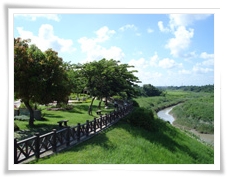
The Erren River was historically known as the "Ercengxing River" until it was officially renamed Erren River by the Taiwan Provincial Government in 1960. Originating from Shanjhu Lake in Mujha Village, Neimen District of Kaohsiung City, the river serves as a natural boundary between Kaohsiung City and Tainan City. The main stream of the Erren River flows through five administrative districts in Kaohsiung City—Neimen, Tianliao, Alian, Hunei, and Cieding—as well as five districts in Tainan City, including Longci, Guanmiao, Gueiren, Rende, and the South District. It finally empties into the Taiwan Strait near the junction of Baishalun in Cieding District and the South District of Tainan City. With a total length of 63.2 kilometers and an average riverbed gradient of 1:142, it is one of the more gently sloping rivers among Taiwan's medium-to-large waterways.
🌿 Environmental Remediation and Ecological Restoration of the Erren River
📍 Pollution History and Key Remediation Milestones
Since the 1970s, the Erren River has been severely contaminated by untreated, toxic heavy-metal wastewater from illegal e-waste smelting and acid-washing industries along its banks, earning the notorious moniker "Black Dragon River." In 2000, the central government collaborated with Kaohsiung and Tainan cities to launch a strict enforcement and long-term remediation campaign, successfully reducing the proportion of severely polluted river sections to under 20%. In recent years, the cleanup has reached two historic turning points: first, a NT$1.36 billion specialized project was launched to excavate and eliminate toxic electronic waste buried deep in the riverbeds under strict ecological supervision; second, authorities are aggressively promoting the recycling of livestock wastewater by establishing centralized processing facilities and expanding municipal sewage systems to cut off pollution at its source.
🌱 Recent Ecological Restoration Achievements
After more than two decades of public-private partnerships, the Erren River is showing remarkable ecological resilience:
- Resurgence of Aquatic Life: Over 30 fish species and 24 crustacean species have been recorded. Traditional "four-hand lift nets" have reappeared on the river, and pollution-sensitive species have returned as a natural indicator of improved water quality.
- Wetland Rebirth: Former e-waste dump sites have been transformed into the thriving Baishalun and Dajia Erhang ecological wetlands through long-term NGO-led restoration, now teeming with fiddler crabs and mudskippers.
- Avian Haven: The restored habitats attract flocks of rare Black-faced Spoonbills for foraging winter through spring. The area has also become a critical conservation site for the first-class protected Eastern Grass Owl.Today, by integrating resources across the corporate, public, academic, and civic sectors, the Erren River is actively seeking international OECM (Other Effective Area-based Conservation Measures) certification, officially transforming from a heavily polluted river into a sustainable ecological sanctuary.
|
|
|
 |
 |
 |
|